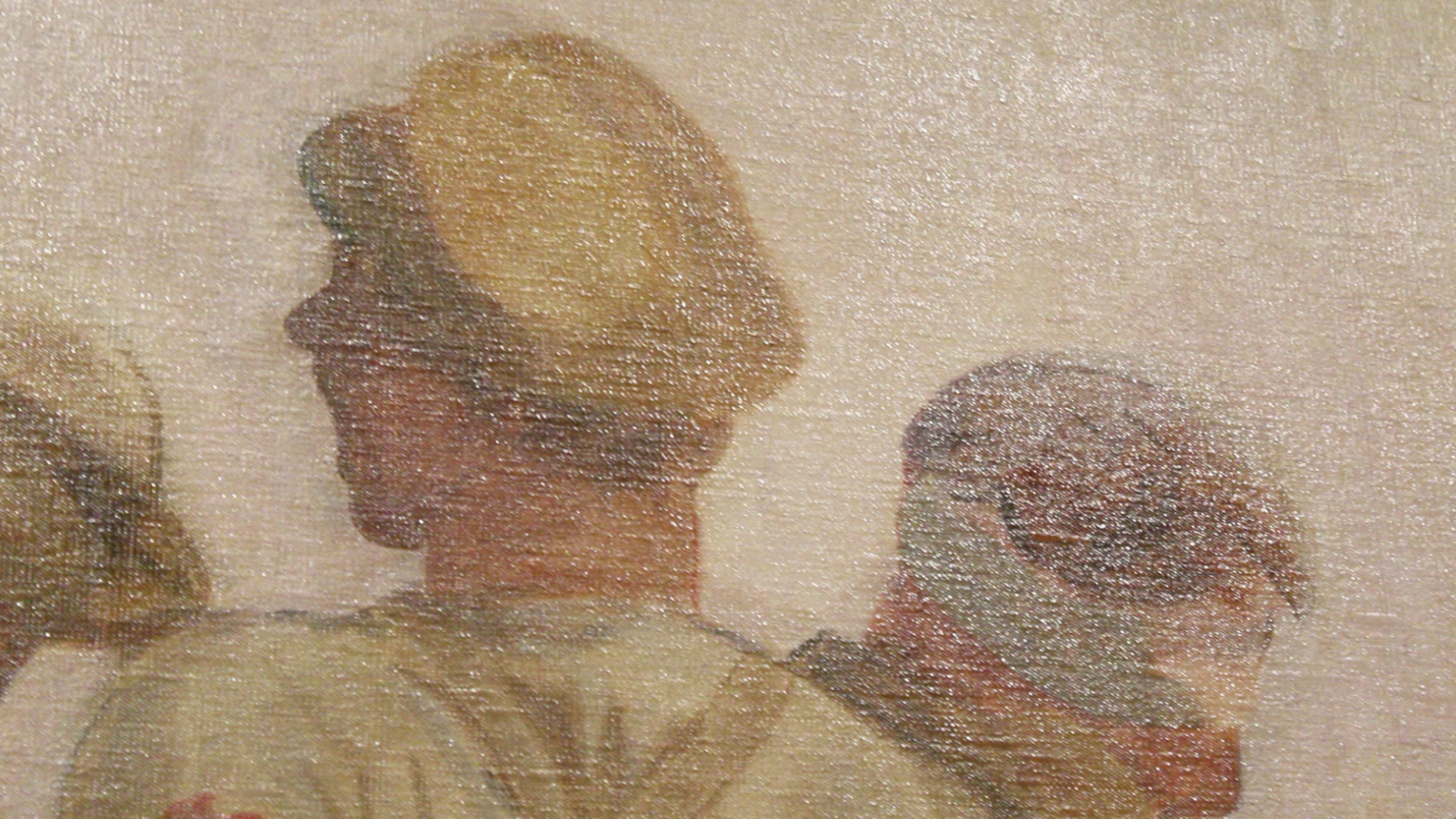
Gassed, 1919
Sargent Season: The Imperial War Museum
Although the Imperial War Museum may seem both out of the way and a little random to this tour of the city, it is perhaps one of the most impactful museums I have ever visited regardless of the Sargent tucked into the third floor Blavatnik Art, Film and Photography Gallery. Gassed, 1919 depicts the medical aftermath of a mustard gas attack on the Western Front during the First World War. A line of soldiers with bandaged eyes are led along by an orderly, each man holding the shoulder of the man in front, while one soldier turns away. It’s an absolutely devastating composition- tens of blinded men shuffling forward in single file, with another line of casualties behind them and more lying in the grass.
If you know anything about Sargent, you would know this piece is pretty unusual as he is often painting more traditional portraits. In 1918, Mr. Sargent was reaching his early 60s, but decided to travel to France and Belgium as a war artist for Britain (a very unlikely choice). The painting was commissioned by the government’s British War Memorials Committee as the centerpiece of a planned national memorial to the First World War’s losses. As an American, he was specifically asked to produce a work embodying Anglo-American cooperation and he truly did just that.

He traveled to the Western Front in July 1918 with another artist, Henry Tonks, spending time with the Guards Division near Arras and then with American forces near Ypres. The actual scene came a bit later and somewhat by accident. Tonks later described in a letter that they’d heard that a dressing station on the Doullens Road was receiving gas casualties, so the two of them went to look. Gassed cases kept arriving, led in parties of about six by an orderly, exactly as Sargent painted them; several hundred men sat or lay on the grass, suffering badly, mostly from their eyes, which were covered with lint, and Sargent was struck enough by the scene to immediately start taking notes and it was in that moment he finally found his subject.
The emotional weight this piece carries is somewhat strange, not because the figures do not hold tension but because the emotions this painting evokes are somewhat disconnected. Why? Well, Sargent found the front unsettlingly undramatic for what the commission wanted. In his own words, “the closer one gets to danger the emptier the landscape becomes,” which left him wondering how both fulfill his commissionioner’s desires and give the scene justice. Gassed makes the mass itself the subject, not heroism, but a procession of the wounded, rendered at over six meters wide so the line of blinded men reads almost life-size.
Why is it where it is now? Well, the Hall of Remembrance itself was never built (the project ran out of time and money) and the Imperial War Museum became the storage unit of the whole series of commissioned paintings instead. Gassed was completed in Sargent’s Fulham studio in 1918–19, first shown at the Royal Academy in 1919, and was voted picture of the year there. It’s now on permanent display at IWM London and has been on near-constant view since that first 1919 exhibition.
While I know it might be a bus or train ride away, I truly think this piece is worth seeing. The grand size of it alone is something you cannot even understand until in person. So here we go everyone, head over to the Imperial War Museum, spend some time on the sunny lawn outfront, grab a coffee nearby, and get ready for the next stop!