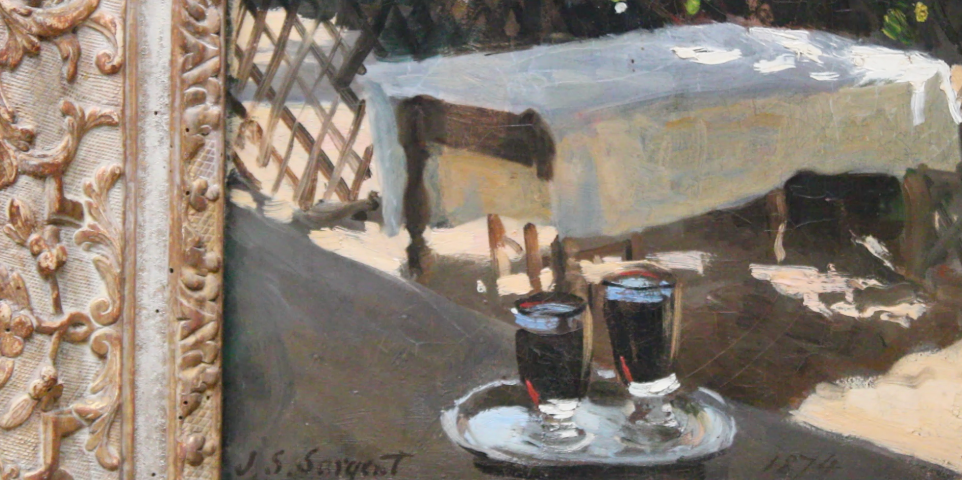
Lord Ribblesdale, 1902 & Wineglasses, 1875
Sargent Season: The National Gallery
Lord Ribblesdale, 1902 — Central Hall, Level 2
You walk into the Central Hall and there’s this enormous full-length figure of a man in hunting clothes, hand on hip and a top hat tipped at an angle (you know it’s Sargent in ten seconds). There’s truly something about the way Sargent paints a person that’s unmistakable once you’ve seen enough of it. It’s literally like recognizing handwriting.
This painting is insane, and part of it is simply its scale. The painting is over eight feet tall, and hung where it is (Central Hall) instead of tucked into a numbered period room. The figure genuinely feels larger than life, almost confrontational in how it commands the space. Sargent elongates Ribblesdale’s already tall frame even further, and the result is a man who seems to loom slightly, like he’s looking down at you from a height that doesn’t quite exist in real life. I don’t know how this Ribblesdale man is, and honestly it doesn’t really matter, the artwork itself without any context is enough to really enjoy the work.
For me, the reason why Sargent is so addictive (and this felt especially true standing in front of Ribblesdale) is his control over where the eye goes. He’ll render a face, a hand, the gleam on a hat brim with this incredible, sharp specificity. He uses thick paint, bright highlights, and hard edges. And then everything around it (the coat, the background, the air of the room) dissolves into washy, blurred, almost unfinished-looking strokes. It’s not laziness, but instead this kind of selection. He’s deciding, brushstroke by brushstroke, what deserves your attention and what should just suggest itself. Imagine a painting with every detail perfectly laid out. How boring!! My favorite type of book is mystery, my favorite tv is true crime. Why? Because everything isn’t given to you, the listener or reader or viewer had to work and engage with the content. Sargent’s style is not a dictionary, but instead a cold case, and that is exactly why I am personally so drawn to it. The effect is something I can only describe as aliveness?? A kind of essence of the human pulled out of the canvas and pushed toward you, while everything else recedes.
Wineglasses, c. 1875 — Room 41, Level 2
A very different kind of vibe with this painting. This one’s small (and early), Sargent was around nineteen when he completed it. The piece lives in Room 41 among Monets and Water Lilies, which makes it feel quiet by comparison. I’ll be honest, portraiture is where my heart is, so a plein-air study of glassware was never going to compete with a hand on a hip and a top hat. But it’s beautiful in its own way. What struck me with this one was the light. There’s a warmth to how the paint sits on the canvas, almost glowing, even at this tiny, unassuming scale. Think about a warm summer evening sitting outside on a patio, the golden sunlight feeling like a hazy, warm, beam. It’s a glimpse of the hand that would later paint Ribblesdale, just not quite sure yet what it wanted to say.
Good work everyone. Go grab a drink or a little snack, we won’t be walking far to our next stop (only about 800 ft) to the National Portrait Gallery. See you there.